

Standing Seam Metal Roof Installation in Jacksonville, FL
Expert Standing Seam Metal Roof Installation for Jacksonville, FL Homes & Businesses
Get expert standing seam metal roof installation in Jacksonville, FL from Red Fox Roofers. Hurricane-rated panels, free estimates. Call (904) 906-4087 today.
- Licensed & Insured
- Locally Owned & Operated
- Free Inspection & Estimate
Request Your
Free EstimateStanding seam metal roof installation is a premium roofing solution that features continuous vertical panels with concealed fasteners and raised interlocking seams that run from ridge to eave. Unlike exposed-fastener metal roofing, standing seam systems keep all mechanical connections hidden beneath the metal surface, dramatically reducing leak points and extending service life to 50 years or more.
In Jacksonville, FL, where Atlantic hurricane seasons, intense subtropical humidity, and salt-laden coastal air push conventional roofing materials to their limits, standing seam metal roofing offers a level of weather resistance that asphalt shingles and other materials simply cannot match. Red Fox Roofers brings deep local expertise to every standing seam installation across Jacksonville and the surrounding communities, engineering each roof to meet Florida Building Code wind uplift requirements while accounting for the unique microclimates found from Riverside to the Beaches.
Call us today at (904) 906-4087 to schedule your free consultation.
Understanding Standing Seam Metal Roof Installation
Standing seam metal roofing is one of the oldest and most proven roofing technologies in American construction history. The system originated in the early 19th century, first appearing on governmental and institutional buildings across the eastern United States. By the late 1800s, standing seam tin roofs were common on Florida’s plantation homes and commercial buildings throughout cities like Jacksonville, where the material’s resistance to fire and tropical storms made it a practical necessity long before modern building codes existed.
Modern standing seam systems have evolved significantly from those early tin panels. Today’s installations typically use Galvalume steel (a zinc-aluminum alloy coating), aluminum, or copper panels ranging from 22 to 26 gauge in thickness. Panels are either field-formed on site using a portable roll-former or factory-fabricated to precise lengths. The defining characteristic is the raised seam — typically 1.5 to 2 inches tall — that mechanically or structurally interlocks adjacent panels without a single exposed fastener penetrating the roofing surface.
Two primary seam types dominate the market. Snap-lock systems feature panels that click together under hand pressure and are ideal for steeper slopes of 3:12 or greater. Mechanically seamed systems use a seaming tool that crimps panels together and can accommodate low-slope applications down to 0.5:12 pitch, making them especially relevant for Jacksonville’s many flat-to-low-slope commercial buildings, warehouses near the Port of Jacksonville, and sprawling ranch-style residential homes found in neighborhoods like Mandarin and Ortega.
Florida’s roofing market has seen standing seam metal installation grow substantially since the 2004 and 2005 hurricane seasons caused catastrophic damage across the state. Homeowners in Jacksonville who experienced losses from Hurricanes Charley, Frances, Ivan, and Jeanne began seeking roofing systems rated for 130 mph or higher wind events. Standing seam metal roofs, when properly installed with engineered clip systems, can achieve wind uplift ratings exceeding 180 mph — a specification now required under Florida Building Code Chapter 15 for high-velocity hurricane zones. In Jacksonville-Duval County, this code requirement directly influences panel gauge selection, clip spacing, and substrate design on every standing seam project Red Fox Roofers completes.
Building types that benefit most from standing seam installation in Jacksonville include single-family residential homes, waterfront properties along the St. Johns River and Intracoastal Waterway, commercial retail centers, medical and professional office buildings, agricultural structures, and historically significant structures where long-term preservation is a priority.
Why Standing Seam Metal Roof Installation Is Needed in Jacksonville, FL
Hurricane and Wind Exposure
Jacksonville sits within the Atlantic hurricane basin and has experienced multiple significant storm events in recent decades. Hurricane Matthew in October 2016 made landfall just 30 miles south of Jacksonville near Cape Canaveral and produced sustained winds of 85 mph over Duval County, causing an estimated $300 million in regional damage and stripping asphalt shingles from thousands of homes in neighborhoods including Arlington, Southside, and the Beaches communities. Hurricane Irma in September 2017 brought sustained winds of 65–75 mph to Jacksonville and produced a record-breaking 2.97-foot storm surge along the St. Johns River, flooding parts of Riverside and San Marco and exposing how vulnerable conventional roofing is to wind-driven rain intrusion at exposed fastener points. Standing seam metal roofing, with its concealed clip system and continuous panel runs, eliminates the fastener failure mode that caused widespread damage during both events.
Subtropical Heat and UV Radiation
Jacksonville averages 233 sunny days per year, with summer temperatures regularly reaching 95°F to 98°F and heat index values exceeding 110°F on the most oppressive July and August afternoons. This sustained UV exposure degrades asphalt shingles at an accelerated rate — Jacksonville’s solar radiation index averages 5.5 to 6.2 kWh/m²/day throughout summer months, comparable to South Florida. Dark asphalt roofs can reach surface temperatures of 160°F to 180°F, accelerating granule loss, cracking, and blistering. Standing seam metal panels with Kynar 500 or Hylar 5000 PVDF paint coatings reflect 25%–40% of solar radiation (depending on color selection) and emit absorbed heat efficiently, reducing attic temperatures by as much as 30°F and lowering cooling costs for Jacksonville homeowners by an estimated 10%–25% annually.
Coastal Salt Air Corrosion
Properties within 5 miles of the Atlantic Ocean — covering communities such as Atlantic Beach, Neptune Beach, Jacksonville Beach, and the eastern portions of Arlington — face accelerated metal corrosion from salt aerosol deposition. Standard galvanized steel roofing can show rust perforation within 15–20 years in these zones. Galvalume steel panels (AZ-55 coating weight) or marine-grade aluminum standing seam panels are specifically engineered for coastal Jacksonville’s salt environment, with aluminum offering essentially indefinite corrosion resistance. Red Fox Roofers specifies substrate material based on each property’s distance from the coastline, ensuring every installation is correctly matched to its corrosion exposure zone.
Rainfall Intensity and Drainage Demands
Jacksonville receives an average of 51 inches of rainfall annually, with summer convective thunderstorms capable of delivering 3 to 5 inches of rain within a single hour. The city’s relatively flat topography — elevations across most of Duval County range from 5 to 35 feet above sea level — means that drainage efficiency is critical. Standing seam panels channel water rapidly from ridge to eave without the tortuous path created by overlapping shingle tabs, reducing the risk of wind-driven rain infiltration during the intense downpours common in the June-through-September wet season.
Termite and Moisture Damage to Roof Decking
The Formosan termite and Eastern subterranean termite populations in Duval County are among the most active in the southeastern United States. Jacksonville’s warm, moist climate enables year-round termite activity. When conventional roofing fails and moisture infiltrates roof decking, termite damage can accelerate dramatically. Standing seam metal’s superior weather exclusion helps preserve decking and structural members, while the installation process allows full decking inspection and treatment before panel installation begins.
Signs You Need Standing Seam Metal Roof Installation in Jacksonville
Structural and Visual Warning Signs
- Asphalt shingles showing granule loss exposing black fiberglass mat, particularly on south- and west-facing roof planes that receive maximum Jacksonville sun exposure
- Curling, cupping, or lifting shingle edges visible from ground level, indicating thermal cycling damage from Jacksonville’s extreme temperature swings between winter lows of 35°F and summer highs near 100°F
- Visible daylight in the attic space around ridge vents, eave boards, or penetration flashings
- Sagging or soft spots in roof decking when inspected from the attic, suggesting long-term moisture infiltration
- Rusting or corroding exposed fasteners on existing metal roofing indicating the coating system has failed
Interior Indicators
- Water stains on ceiling drywall or insulation, particularly after Jacksonville’s summer thunderstorm events
- Mold or mildew odors in attic spaces during high-humidity months (May through October)
- Unexplained spikes in cooling energy bills suggesting attic heat gain from a deteriorated roof system
- Peeling paint on interior ceiling surfaces near exterior walls
Age-Related Urgency Indicators
- Existing asphalt shingle roof is 15 years or older — in Jacksonville’s climate, shingles typically reach functional end-of-life by year 15–18
- Previous roof repairs have been performed within the last 3 years without resolving leaks
- Upcoming hurricane season (June 1–November 30) with a roof in questionable condition
- Property is being listed for sale or refinanced and roof condition affects appraisal or insurance placement
Our Standing Seam Metal Roof Installation Process in Jacksonville
Comprehensive Roof Assessment (Day 1 — 2–4 Hours)
Red Fox Roofers begins every project with a detailed inspection of your existing roof system. Our Jacksonville-experienced technicians evaluate decking integrity, existing insulation, ventilation adequacy, drainage patterns, and structural load capacity. For coastal properties in Atlantic Beach and Neptune Beach, we assess salt corrosion levels on any existing metal components. We document all findings with photographs and provide a written scope of work before any project begins.
Engineering, Permitting, and Material Specification (Days 2–10)
All standing seam metal roof installations in Duval County require a building permit from the City of Jacksonville Building Inspection Division. Red Fox Roofers prepares permit applications, engineered drawings where required, and product approval documentation confirming Florida Product Approval (FPA) listings for selected panels. We specify panel gauge, clip spacing, and substrate assembly to meet or exceed the required wind speed design pressure for your specific address and exposure category. Permit approval in Jacksonville typically takes 5–10 business days.
Material Procurement and Delivery (Days 7–14)
We source Galvalume steel or aluminum panels from Florida-stocked distributors to minimize lead times. For custom-length panels over 30 feet — common on Jacksonville’s larger ranch and two-story homes — we coordinate field roll-forming equipment delivery to your property.
Tear-Off and Decking Preparation (Day 1 of Installation — Full Day)
Existing roofing materials are removed and disposed of in compliance with Duval County waste management guidelines. Decking is inspected board by board; any rotted or damaged plywood or OSB is replaced with code-compliant 5/8-inch plywood. A self-adhering underlayment (peel-and-stick ice and water shield) is applied to all eaves, valleys, and penetrations — critical in Jacksonville where wind-driven rain can force water upslope under panels during severe storms.
Underlayment and Panel Installation (Days 2–4 of Installation)
High-temperature synthetic underlayment (rated to 265°F surface temperature) is installed over the full deck before panels are set. Standing seam panels are installed from eave to ridge using factory-specified clip spacing, with thermal expansion gaps accommodated for Jacksonville’s annual temperature range. All penetrations — pipe boots, HVAC curbs, skylights — are flashed using matching metal flashing and sealant systems rated for Florida’s UV exposure.
Ridge, Hip, and Trim Installation (Day 4–5)
Ridge caps, hip caps, rake trim, and eave drip edge are installed and mechanically fastened per manufacturer specifications. Ventilation components are integrated at the ridge to maintain attic airflow, which is especially important in Jacksonville’s high-humidity climate.
Final Inspection and Quality Walk-Through (Day 5–6)
A City of Jacksonville building inspection is scheduled and completed. Red Fox Roofers conducts an independent quality assurance inspection covering seam integrity, fastener patterns, flashing details, and drainage performance. The completed inspection report and permit documentation are provided to you for your homeowner records.
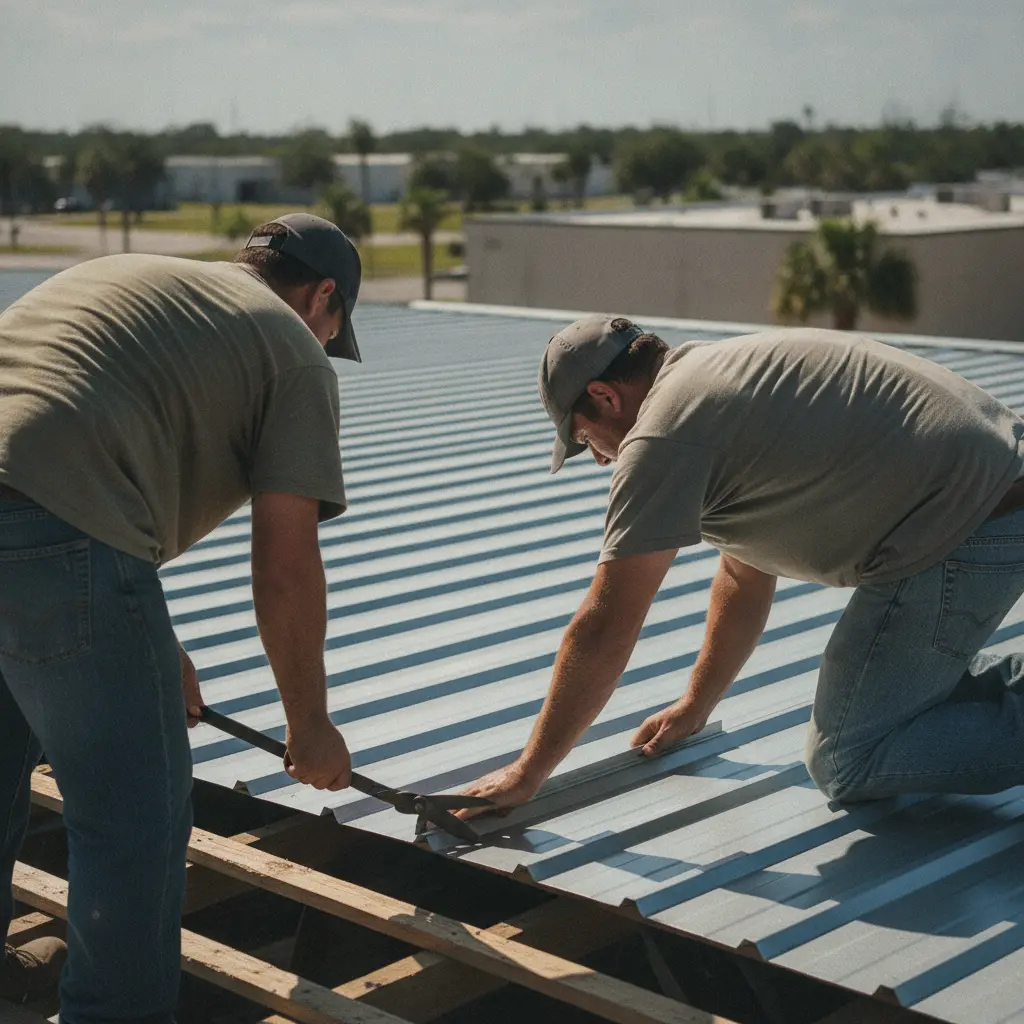
Our team in action — roofing professionals serving Jacksonville
Standing Seam Metal Roof Installation Methods and Approaches
Snap-Lock Standing Seam Systems
Snap-lock panels are the most widely used standing seam method for residential installations in Jacksonville. Panels feature a male and female leg that snap together under pressure without requiring a mechanical seaming tool. This system is ideal for roof slopes of 3:12 or steeper, which encompasses the majority of Jacksonville’s single-family residential stock in areas like Mandarin, Avondale, and San Marco. Snap-lock systems are faster to install than mechanically seamed alternatives and deliver excellent weather resistance for standard residential applications.
Mechanically Seamed (Double-Lock) Systems
Mechanically seamed standing seam uses an electric seaming machine to double-fold panel legs together after placement, creating a watertight joint of superior integrity. This system is required on low-slope applications below 2:12 pitch and is the preferred choice for Jacksonville’s commercial buildings, warehouses near the Dames Point industrial corridor, and roofs exposed to extreme wind uplift. The double-lock seam achieves the highest wind resistance ratings and is specified on projects requiring FM Approvals or ASCE 7 compliance.
Structural vs. Architectural Standing Seam
Structural standing seam panels are engineered to span between purlins without a continuous solid deck, making them appropriate for commercial and agricultural applications including equestrian facilities in Fruit Cove and Palm Valley. Architectural standing seam requires a continuous decked substrate and is the standard for Jacksonville residential installations where Florida Building Code requires solid decking for wind resistance compliance.
Retrofit Over Existing Roofing
In specific conditions where existing decking is sound and slope geometry permits, standing seam panels can be installed over existing roofing using a strapping or recovery board system. This approach eliminates tear-off costs and keeps existing materials out of the waste stream. Red Fox Roofers evaluates retrofit suitability on a case-by-case basis, ensuring the assembly meets current Florida Building Code requirements and does not exceed structural load limits.
Ready for Standing Seam Metal Roof Installation? Get Your Free Estimate Today.
Red Fox Roofers serves Jacksonville and the surrounding area — we’ll be on-site within 24 hours.
📞 Call (904) 906-4087Standing Seam Metal Roof Installation Cost in Jacksonville, FL
Understanding the cost of standing seam metal roof installation in Jacksonville helps property owners budget accurately and evaluate proposals from roofing contractors. Pricing in the Jacksonville market reflects both national material costs and Florida-specific labor, permitting, and code compliance factors.
Typical Price Ranges
- Residential standing seam (Galvalume steel, snap-lock): $12.00–$18.00 per square foot installed, including tear-off, underlayment, and permit
- Residential standing seam (aluminum, coastal specification): $15.00–$22.00 per square foot installed — aluminum carries a premium appropriate for Atlantic Beach, Neptune Beach, and Jacksonville Beach properties within 1–3 miles of the ocean
- Commercial standing seam (mechanically seamed, structural): $10.00–$16.00 per square foot installed depending on building complexity and panel specification
- Average Jacksonville home (2,000 sq ft living area, approximately 2,200–2,400 roofing sq ft): Total project cost typically ranges from $26,400 to $52,800
Key Cost Factors in Jacksonville
- Panel material: Galvalume steel is the most economical; aluminum costs 20%–35% more; copper commands a significant premium for historic or luxury applications
- Roof complexity: Multiple valleys, hips, dormers, and penetrations increase labor hours and waste factor
- Decking replacement: Damaged plywood replacement adds $2.00–$4.50 per square foot for affected areas
- Duval County permit fees: Residential roofing permits typically range from $150 to $650 depending on project valuation
- Paint system: Standard polyester paint versus premium Kynar 500 PVDF coating adds approximately $0.50–$1.50 per square foot but significantly extends color durability in Jacksonville’s UV environment
Red Fox Roofers provides detailed written estimates with line-item pricing. Call (904) 906-4087 to schedule your free roof inspection and cost assessment.
Neighborhoods We Serve in Jacksonville and Surrounding Areas
Riverside and Avondale
These historic neighborhoods feature homes built primarily between 1900 and 1940, many with original wood-framed roof structures and steep-pitched designs well-suited to standing seam installation. The area’s tree canopy creates a debris challenge during storms, and historic district guidelines may influence color and profile selection. Red Fox Roofers has experience navigating Jacksonville’s Historic Preservation Commission requirements for properties within designated historic districts.
Mandarin and Fruit Cove
Mandarin’s residential stock spans the 1970s through 2000s, featuring predominantly low- to medium-slope hip roofs on large ranch and two-story homes. Many properties here are approaching or past the 20-year mark on original asphalt shingles. Fruit Cove, in neighboring St. Johns County, features newer construction with larger roof footprints where standing seam’s longevity delivers exceptional value.
Atlantic Beach and Neptune Beach
These Beaches communities require marine-grade material specifications due to salt air exposure. Post-1990 construction here typically features concrete block structures with complex rooflines. Aluminum standing seam panels are frequently specified for properties within two miles of the Atlantic Ocean shoreline. Learn more about our Atlantic Beach roofing services.
Southside and Baymeadows
Jacksonville’s Southside corridor contains significant commercial and medical office inventory alongside residential developments from the 1980s and 1990s. Commercial standing seam projects in this area frequently require FM-approved assemblies for insurance compliance.
San Marco
San Marco’s 1920s–1950s bungalows and Mediterranean Revival homes present unique restoration opportunities where standing seam’s historical precedent aligns perfectly with the neighborhood’s architectural character. Explore all our metal roofing options.
Maintenance Tips for Standing Seam Metal Roofs in Jacksonville
- Bi-annual inspections: Schedule professional inspections every spring (before hurricane season, June 1) and fall (after hurricane season, December) to identify any panel movement, sealant deterioration, or flashing issues before they become leaks.
- Clear debris after storms: Jacksonville’s mature oak and pine trees drop branches, leaves, and pine needles that can accumulate in valleys and at eave lines, retaining moisture and accelerating corrosion at panel edges. Clear debris within 48 hours of any significant storm.
- Keep gutters clean: Jacksonville’s wet season generates enormous leaf volume. Clogged gutters cause water to back up under eave trim, one of the few vulnerable points on a standing seam roof system.
- Inspect sealants at penetrations: Pipe boot sealants and curb flashing sealants degrade under Jacksonville’s UV intensity. Inspect and reapply sealant at all penetrations every 5–7 years.
- Avoid foot traffic: Walking on standing seam panels can deform seams and scratch protective coatings. Use walkway pads if roof access is needed for HVAC or solar maintenance.
- Check for galvanic corrosion: Ensure no dissimilar metals (copper pipes, aluminum gutters on steel panels) are in direct contact without isolation barriers.
- Rinse coastal properties: For Atlantic Beach and Neptune Beach homes, a low-pressure freshwater rinse of roof panels twice yearly removes salt deposits that accelerate coating breakdown.
- Trim overhanging branches: Reduce debris load and eliminate the risk of branch impact damage during Jacksonville’s frequent summer thunderstorms and tropical weather events.
Why Choose Red Fox Roofers for Standing Seam Metal Roof Installation in Jacksonville
Red Fox Roofers is a Jacksonville-based roofing contractor with hands-on experience across the full range of roofing systems used in Northeast Florida. Our team understands the specific challenges that Jacksonville’s subtropical climate, coastal exposure, and Florida Building Code requirements create for every roofing project we undertake.
We specialize in metal roofing, roof replacement, commercial roofing, and the full spectrum of residential roofing services including shingle roofing, tile roofing, TPO roofing, flat roofing, EPDM rubber roofing, roof coating, and roof restoration. This breadth of expertise means we can honestly recommend whether standing seam is the right solution for your specific building and budget — or whether another system better fits your needs.
Every Red Fox Roofers installation begins with a thorough roof inspection and concludes with a completed building permit signed off by the City of Jacksonville. We serve Jacksonville, Atlantic Beach, Neptune Beach, Jacksonville Beach, Palm Valley, and Fruit Cove. Call us today at (904) 906-4087 to speak with a Jacksonville roofing specialist.
Frequently Asked Questions: Standing Seam Metal Roof Installation in Jacksonville, FL
How much does standing seam metal roof installation cost in Jacksonville, FL?
In the Jacksonville market, standing seam metal roof installation typically costs between $12 and $22 per square foot fully installed, depending on panel material (Galvalume steel vs. aluminum), roof complexity, and whether decking replacement is required. A 2,200-square-foot roof on a typical Jacksonville single-family home generally falls in the $26,400 to $48,400 range. Coastal properties in Atlantic Beach and Neptune Beach often fall at the higher end due to aluminum specification requirements. Red Fox Roofers provides free, detailed written estimates — call (904) 906-4087 to schedule yours.
How long does standing seam metal roof installation take in Jacksonville?
For a standard residential installation in Jacksonville, the physical installation phase typically takes 3 to 5 days after permits are approved. Permitting through the City of Jacksonville Building Inspection Division generally takes 5 to 10 business days. Custom-fabricated panel orders may extend the total project timeline by 1 to 2 weeks. Commercial projects vary based on building size and complexity.
Do standing seam metal roofs hold up to Jacksonville hurricanes?
Yes — when properly engineered and installed. Standing seam metal roofing systems with concealed clip fasteners can achieve wind uplift ratings of 150 to 180+ mph when installed per Florida Product Approval specifications and Duval County building permit requirements. Red Fox Roofers designs every standing seam installation to meet or exceed the Florida Building Code wind speed requirements for Jacksonville’s exposure category, which is critical given the Atlantic hurricane threat the region faces every June through November.
Is standing seam metal roofing worth the cost compared to asphalt shingles in Jacksonville?
For most Jacksonville property owners planning to stay in their home for 10 or more years, standing seam metal delivers strong long-term value. While the upfront cost is 2 to 3 times higher than a quality architectural shingle roof, standing seam systems last 50+ years versus 15–20 years for asphalt shingles in Jacksonville’s climate. The energy savings (10%–25% cooling cost reduction), insurance premium discounts available for impact-resistant metal roofing in Florida, and elimination of repeated repair and replacement costs typically produce a positive financial outcome over the roof’s life.
Do I need a permit for standing seam metal roof installation in Jacksonville?
Yes. All roofing system replacements in Duval County require a building permit from the City of Jacksonville Building Inspection Division. Red Fox Roofers handles the complete permitting process on your behalf, including Florida Product Approval documentation for the specific standing seam system being installed. Never hire a roofing contractor who suggests skipping the permit process — unpermitted roofing work creates significant problems at resale and may void homeowner’s insurance claims.
Can standing seam metal be installed on a flat or low-slope roof in Jacksonville?
Yes, with the correct system specification. Mechanically seamed (double-lock) standing seam panels can be installed on slopes as low as 0.5:12, making them suitable for Jacksonville’s commercial buildings, retail centers, and flat-to-low-slope residential applications. These systems require structural-grade panels and specific underlayment assemblies to perform at minimal pitch. Red Fox Roofers evaluates slope geometry during the initial assessment to confirm system suitability.
What colors and finishes are available for standing seam roofs in Jacksonville?
Modern standing seam panels are available in dozens of standard colors and can be custom-matched for historic properties. For Jacksonville’s intense UV environment, Red Fox Roofers recommends Kynar 500 or Hylar 5000 PVDF paint systems, which carry 30-year finish warranties and retain color fidelity far better than standard polyester paints under Florida’s solar radiation levels. Light and medium tones with high solar reflectance indices (SRI) qualify for Florida’s energy code cool roof credits and reduce cooling loads meaningfully in Jacksonville’s climate.
Does Red Fox Roofers service areas outside Jacksonville proper?
Yes. Red Fox Roofers serves Jacksonville, Atlantic Beach, Neptune Beach, Jacksonville Beach, Palm Valley, and Fruit Cove. View our full service area or call (904) 906-4087 to confirm coverage for your specific address.
Get Your Free Standing Seam Metal Roof Estimate in Jacksonville Today
If you’re ready to protect your Jacksonville home or commercial building with a standing seam metal roof engineered for Florida’s toughest conditions, Red Fox Roofers is ready to help. Our Jacksonville roofing specialists will inspect your current roof, walk you through the right system for your building and budget, and provide a clear, itemized written estimate with no hidden costs and no pressure.
With hurricane season running June 1 through November 30, there’s no better time to upgrade to a roofing system that’s built to last decades and handle whatever the Atlantic basin sends our way.
Call Red Fox Roofers now at (904) 906-4087 to schedule your free inspection and estimate. We serve Jacksonville, Atlantic Beach, Neptune Beach, Jacksonville Beach, Palm Valley, and Fruit Cove. Contact us online to request your appointment today.