

Emergency Roof Repair in Jacksonville, FL
24/7 Emergency Emergency Roof Repair Available in Jacksonville, FL
Need emergency roof repair in Jacksonville, FL? Red Fox Roofers responds fast to storm damage, leaks & more. Call (904) 906 40-87 for immediate help.
- Licensed & Insured
- Locally Owned & Operated
- Free Inspection & Estimate
Request Your
Free EstimateWhen a sudden storm tears through Jacksonville and water starts pouring into your home, every minute counts. Emergency roof repair is an immediate, specialized response to unexpected roof failures caused by storm damage, falling debris, structural collapse, or severe leaks that threaten the safety and integrity of your property. Unlike scheduled maintenance, emergency repairs must be executed fast — often within hours — to prevent escalating damage to ceilings, insulation, electrical systems, and personal belongings.
Jacksonville’s unique geography places it squarely in the path of Atlantic hurricane systems, seasonal tropical storms, and intense afternoon thunderstorms that can strip shingles, crack tiles, and compromise flashing in an instant. At Red Fox Roofers, we understand the urgency that Jacksonville homeowners and business owners face when their roof fails without warning. Our local team is trained to respond rapidly across Jacksonville and surrounding communities, delivering expert emergency roof repair when you need it most. Call us now at (904) 906 40-87.
Understanding Emergency Roof Repair
Emergency roof repair is a distinct category of roofing service defined by its urgency, scope, and reactive nature. While routine roof maintenance and scheduled repairs are planned well in advance, emergency repair is triggered by sudden, unforeseen events that leave a structure exposed to the elements. The primary goal is not necessarily a permanent fix but rather a rapid stabilization of the damage to prevent further loss — followed, where necessary, by a comprehensive repair or replacement plan.
Historically, roofing emergencies in the Southeast United States have been closely tied to the region’s vulnerability to tropical weather systems. Jacksonville, incorporated in 1832 and developed rapidly throughout the 20th century, contains a wide spectrum of roofing types across its residential and commercial building stock. Older neighborhoods like Springfield and Riverside feature homes built in the early 1900s with original wood decking and aging shingle systems, while newer developments in areas like Nocatee and Bartram Park feature modern architectural shingles, tile, and flat roofing systems. Each of these roof types has specific vulnerabilities and requires tailored emergency response techniques.
Common roofing materials found in Jacksonville include asphalt shingles, clay and concrete tile, metal roofing, flat membrane systems such as TPO and EPDM, and built-up roofing (BUR) on commercial structures. Emergency repair approaches differ significantly across these systems. A blown-off section of a tile roof requires temporary tarping and structural bracing, while a punctured TPO membrane on a commercial flat roof may require heat-welded patching to restore watertightness.
In Jacksonville’s dense urban core and sprawling suburban zones — which together cover more than 874 square miles, making it the largest city by area in the contiguous United States — roofing emergencies affect single-family homes, townhomes, condominiums, strip malls, warehouses, and multi-family complexes alike. The sheer diversity of the building stock means that a qualified emergency roofing team must be equipped with the materials, tools, and expertise to address virtually any roofing system under high-pressure, time-sensitive conditions. Learn more about our general roof repair services.
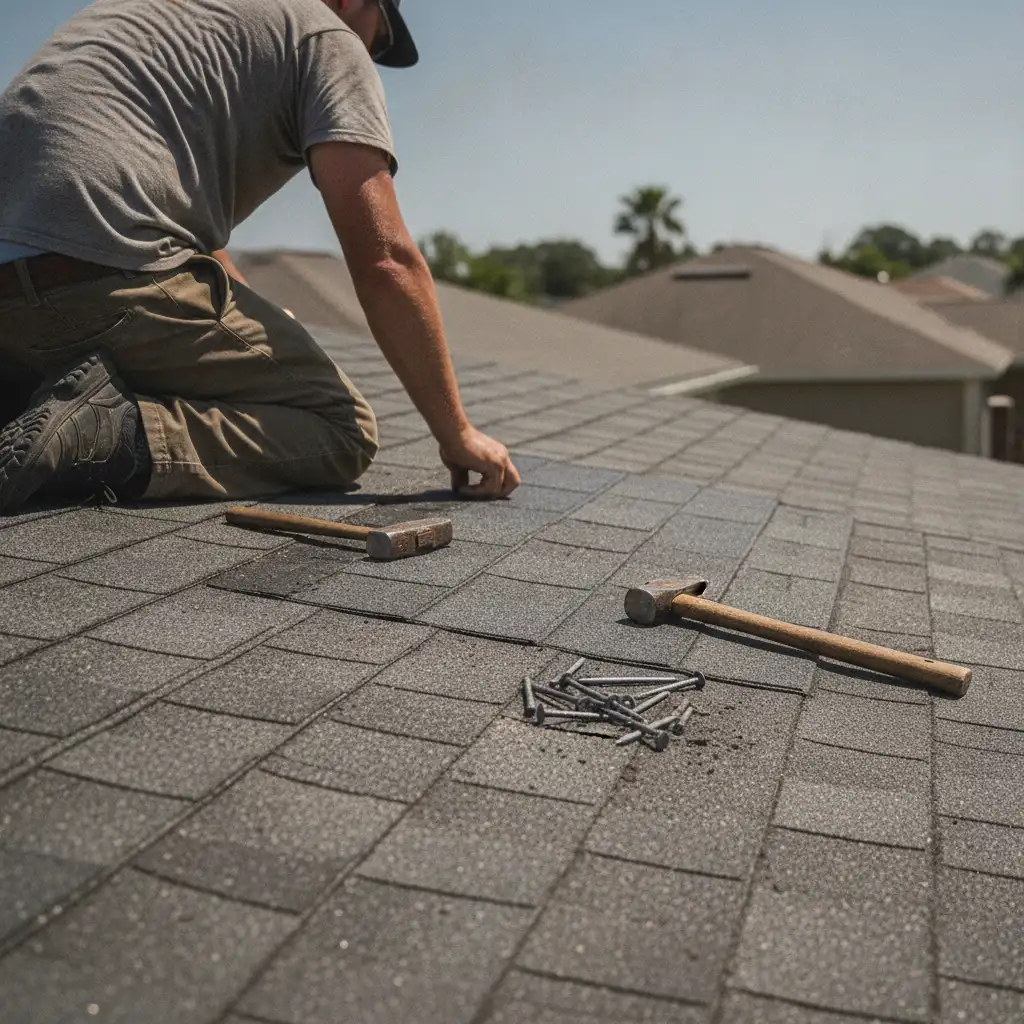
Our team in action — roofing professionals serving Jacksonville
Why Emergency Roof Repair Is Needed in Jacksonville, FL
Hurricane and Tropical Storm Activity
Jacksonville sits at approximately 30.3°N latitude along the First Coast, placing it within the Atlantic hurricane belt. The city has been directly impacted or significantly affected by numerous named storms. Hurricane Irma in September 2017 produced a historic storm surge of approximately 3–4 feet in the St. Johns River, flooding entire neighborhoods including San Marco, Riverside, and Ortega while simultaneously driving sustained winds of 65–75 mph that stripped roofing materials across thousands of structures. Hurricane Matthew in October 2016 caused an estimated $1.3 billion in damage in Duval County alone, with roofing damage reported in virtually every zip code. More recently, remnants of Hurricane Ian in 2022 brought heavy rainfall exceeding 8 inches in under 24 hours to parts of Jacksonville, overwhelming roofing systems already stressed by age or prior damage.
Intense Afternoon Thunderstorms
Between June and September, Jacksonville experiences a pronounced wet season driven by the Atlantic sea breeze and Gulf moisture. The city averages approximately 52 inches of rainfall per year, much of it falling in intense, localized bursts. These storms frequently generate wind gusts exceeding 50 mph, hail events with stones measuring 0.75 to 1.5 inches in diameter, and lightning strikes that can fracture roofing materials or ignite structural components. The Southside, Arlington, and Mandarin neighborhoods, developed primarily between the 1960s and 1990s, contain large numbers of aging asphalt shingle roofs that are highly vulnerable to hail impact and wind uplift at these speeds.
Salt Air Corrosion on the Beaches
Coastal communities in the Jacksonville service area — including Atlantic Beach, Neptune Beach, and Jacksonville Beach — face an additional hazard: salt-laden air that accelerates the corrosion of metal flashing, fasteners, and roofing components. Properties within one mile of the Atlantic Ocean can experience metal corrosion at rates two to five times faster than inland structures. This salt exposure degrades roof systems faster, meaning that a storm that might only dislodge a few shingles on an inland home can cause catastrophic flashing failure on a beachside property.
Sandy Soil and Foundation Movement
Jacksonville’s underlying geology consists largely of sandy, porous soils and ancient limestone formations. While this primarily affects foundations and slabs, structural movement caused by soil shifting — particularly in older neighborhoods like Springfield, Brentwood, and Panama Park — can create racking in roof framing over time. When a severe storm adds sudden uplift forces to an already-racked structure, the result can be sudden, widespread roof failure requiring immediate emergency intervention.
Urban Tree Canopy Hazards
Jacksonville is known for its extensive urban tree canopy, particularly mature live oaks and pine trees in neighborhoods like Avondale, Ortega, and San Marco. During storms, these large trees frequently shed limbs or topple entirely, causing catastrophic punctures or collapse sections in residential roofing systems. Fallen tree damage is one of the most common triggers for emergency roof repair calls in Duval County.
Signs You Need Emergency Roof Repair in Jacksonville
Visible Structural Damage
- Missing, cracked, or visibly displaced shingles, tiles, or membrane panels
- Sagging or bowing sections of the roof deck visible from the ground or attic
- Fallen tree limbs resting on or embedded in the roof surface
- Exposed roof decking or underlayment visible after a storm
Interior Water Intrusion
- Active dripping or flowing water inside the structure during or after rain
- Water stains on ceilings or walls that appeared suddenly after a storm event
- Bubbling or peeling paint on interior ceilings indicating moisture accumulation
- Damp or wet insulation visible in the attic space
Immediate Urgency Indicators
- Daylight visible through the attic or roof deck — a direct indicator of a compromised barrier
- Electrical issues coinciding with roof damage, suggesting water contact with wiring
- A sudden and significant increase in indoor humidity or musty odor following storm activity
- Wind-driven rain entering through attic vents, ridge caps, or damaged flashing
If you observe any of these signs, do not wait. Jacksonville’s high humidity and heat create ideal conditions for mold growth, which can begin developing within 24–48 hours of water intrusion. Schedule a roof inspection for non-emergency concerns.
Emergency Roof Repair Methods and Approaches
Emergency Tarping and Temporary Covering
The most immediate form of damage control, heavy-duty polyethylene tarps (minimum 6-mil thickness) are secured over exposed areas using battens and fasteners that avoid additional penetrations to the roof deck. This method is appropriate for virtually all roof types and is the standard first response for Jacksonville properties after major storm events.
Shingle Patching and Replacement
For asphalt shingle roofs — the most common roofing type in Jacksonville’s residential neighborhoods — missing or damaged shingles are replaced with matching materials, and new underlayment is applied where the deck is exposed. Learn about our shingle roofing services.
Membrane Patching for Flat and Low-Slope Roofs
Jacksonville’s significant commercial and multi-family building stock relies heavily on TPO and EPDM flat roofing systems. Emergency membrane repairs involve cleaning the damaged area, applying compatible patch material, and heat-welding or adhesive-bonding the patch for a watertight seal. Explore our TPO roofing services and learn about EPDM rubber roofing.
Flashing Repair and Re-Sealing
Failed or lifted flashing at chimneys, vents, skylights, and roof edges is a leading cause of emergency leaks in Jacksonville’s coastal communities where salt air accelerates metal degradation. We replace or re-seal flashing using corrosion-resistant materials suited to the marine environment of Jacksonville Beach and Atlantic Beach.
Structural Stabilization
When storm or impact damage compromises roof framing members — rafters, trusses, or decking — temporary structural supports are installed before any surfacing repair is made. This is particularly relevant for older Springfield and Riverside homes with original wood framing.
Ready for Emergency Roof Repair? Get Your Free Estimate Today.
Red Fox Roofers serves Jacksonville and the surrounding area — we’ll be on-site within 24 hours.
📞 Call (904) 906-4087Emergency Roof Repair Cost in Jacksonville, FL
The cost of emergency roof repair in Jacksonville varies based on the severity of damage, roofing material, accessibility, and whether the work is performed during or after a storm event. Below are general price ranges to help you plan.
Typical Cost Ranges
- Emergency tarping (temporary covering): $300–$800 depending on roof area and complexity
- Minor shingle repair (up to 10 square feet): $250–$600
- Moderate shingle repair (10–50 square feet): $600–$1,500
- Flashing repair or replacement: $400–$1,200
- Flat roof membrane patch: $500–$1,800 depending on membrane type and patch area
- Structural deck repair (per section): $800–$3,500+
- Tile roof emergency repair: $600–$2,500 depending on tile type and extent
- Full emergency assessment and report: $150–$400 (often credited toward repair cost)
Jacksonville-Specific Cost Factors
Several local factors influence emergency roofing costs in Jacksonville. Post-hurricane demand surges — as seen after Irma in 2017 and Matthew in 2016 — can increase labor costs by 20–40% due to high call volumes region-wide. Properties in Atlantic Beach and Jacksonville Beach may face higher material costs due to the requirement for corrosion-resistant fasteners and flashing. Older homes in Riverside and Springfield may require deck replacement that adds to the overall scope. Most standard homeowner insurance policies in Florida cover wind and storm roof damage, significantly reducing out-of-pocket costs. We strongly recommend contacting your insurer immediately after discovering damage. Consider roof coating for long-term protection after repairs.
Jacksonville Neighborhoods We Serve
Riverside and Avondale
These historic neighborhoods feature homes built primarily between 1910 and 1940, many with original wood shake or early asphalt shingle systems over board-and-batten decking. Emergency repairs here often require careful handling of aging structural components.
San Marco and Southside
A mix of mid-century homes and modern commercial developments. Flat and low-slope commercial roofing systems in Southside’s business corridors are frequent candidates for emergency TPO and EPDM repair.
Mandarin and Fruit Cove
Predominantly 1980s–2000s residential construction with asphalt shingle roofs that face significant wear from decades of Florida sun and storm exposure. Many properties here are in need of storm damage assessment after each hurricane season.
Atlantic Beach and Neptune Beach
Coastal properties face accelerated corrosion from salt air. Emergency flashing repair and metal component replacement are particularly common in these beachside communities.
Bartram Park and Palm Valley
Newer developments with modern tile and architectural shingle roofs. These communities were established from the early 2000s onward and face wind uplift challenges due to open, less wind-sheltered suburban layouts.
Roof Maintenance Tips for Jacksonville Homeowners
Proactive maintenance significantly reduces the likelihood of a roofing emergency. Here are location-specific tips every Jacksonville property owner should follow:
- Inspect your roof after every named storm — Even if damage isn’t immediately obvious, high winds and debris can dislodge flashing and crack tiles invisibly.
- Trim overhanging tree branches annually — Jacksonville’s dense live oak canopy is beautiful but dangerous. Keep limbs at least 6 feet clear of the roofline.
- Clean gutters before and after hurricane season (June–November) — Blocked gutters cause water to back up under roofing materials, accelerating deterioration.
- Check and reseal flashing every 2–3 years — Especially critical for coastal properties in Atlantic Beach and Neptune Beach where salt air degrades sealants faster.
- Schedule a professional roof inspection annually — Particularly before hurricane season begins each June. Book a roof inspection with Red Fox Roofers.
- Apply reflective roof coating on flat and low-slope roofs — Jacksonville’s average of 233 sunny days per year accelerates membrane degradation. Coatings extend roof life by years. Learn about roof coating options.
- Check attic ventilation — Poor attic ventilation in Jacksonville’s heat and humidity accelerates decking deterioration from below, weakening your roof structure before a storm even arrives.
Why Choose Red Fox Roofers for Emergency Roof Repair in Jacksonville
When your roof fails and water is entering your home or business, you need a roofing team that knows Jacksonville — not a call center dispatching unfamiliar contractors from out of state. Red Fox Roofers is a locally rooted roofing company serving Jacksonville and the First Coast community with deep knowledge of local building codes, weather patterns, and the specific roofing challenges that Duval County properties face.
We are equipped to handle emergency repairs on every major roofing system found in Jacksonville, from historic wood-framed homes in Riverside to modern TPO commercial roofs in the Southside business district to salt-exposed coastal properties on Jacksonville Beach. Our team arrives prepared — with materials, tools, and tarping supplies on every vehicle — so we can begin stabilizing your roof immediately upon arrival.
We provide thorough damage documentation to support your insurance claim, clear written estimates with no hidden fees, and responsive communication throughout the repair process. Whether you are dealing with post-hurricane devastation or a sudden leak from an afternoon thunderstorm, Red Fox Roofers delivers professional, reliable emergency roofing service across Jacksonville and all surrounding communities.
Call us any time at (904) 906 40-87 for immediate emergency assistance.
Frequently Asked Questions: Emergency Roof Repair in Jacksonville, FL
How quickly can Red Fox Roofers respond to a roofing emergency in Jacksonville?
Response times vary depending on storm conditions and call volume, but we prioritize emergency calls and aim to have a crew on-site as quickly as possible — often within a few hours for active emergencies in the Jacksonville metro area. During major storm events such as post-hurricane periods, demand across the region increases significantly, but we triage calls and dispatch as efficiently as possible.
How much does emergency roof repair cost in Jacksonville, FL?
Emergency roof repair in Jacksonville typically ranges from $300 for basic temporary tarping to $3,500 or more for extensive structural and surface repairs. Most insurance-covered repairs involve minimal out-of-pocket expense beyond your deductible. We provide itemized written estimates before permanent repair work begins. See our cost section above for a full breakdown by repair type.
Will my homeowner’s insurance cover emergency roof repair in Jacksonville?
Most standard Florida homeowner’s insurance policies cover roof damage caused by wind, hail, and falling objects — all common causes of emergency roofing calls in Jacksonville. Coverage specifics depend on your policy, your roof’s age, and the cause of damage. We provide detailed damage documentation and can work alongside your insurance adjuster to support your claim.
What should I do immediately after storm damage to my Jacksonville roof?
First, ensure all occupants are safe and avoid standing under compromised ceiling areas. Do not attempt to climb onto your roof — leave that to professionals. Move valuables and electronics away from active leaks. Document visible interior damage with photographs. Then call Red Fox Roofers at (904) 906 40-87 for immediate assistance and contact your insurance company to open a claim.
Can you repair all roof types in Jacksonville emergency situations?
Yes. Red Fox Roofers is equipped to provide emergency repair on asphalt shingles, clay and concrete tile, metal roofing, flat membrane systems (TPO and EPDM), and built-up roofing systems. We serve the full spectrum of residential and commercial roofing found across Jacksonville’s diverse building stock, from century-old Riverside bungalows to modern Southside commercial facilities. Learn about our metal roofing services and explore tile roofing options.
How long does a temporary emergency tarp last before permanent repairs are needed?
A properly installed heavy-duty tarp can protect a Jacksonville roof for 30–90 days under normal conditions. However, given Jacksonville’s intense UV exposure, summer heat exceeding 95°F, and the possibility of additional storm activity during hurricane season (June through November), we strongly recommend scheduling permanent repairs as quickly as possible after temporary stabilization.
Do you serve areas outside of Jacksonville proper?
Yes. Red Fox Roofers serves all of our listed service areas including Atlantic Beach, Neptune Beach, Jacksonville Beach, Palm Valley, and Fruit Cove. We cover the full First Coast region and respond to emergencies throughout the greater Jacksonville metro area.
Is there anything I can do safely while waiting for your crew to arrive?
From inside the structure only, you can place buckets or towels under active drips, use plastic sheeting to cover and protect furniture and electronics, and take photographs of interior water intrusion for insurance purposes. Do not go onto the roof yourself — especially after storm events, when surfaces may be wet, structurally compromised, or obscured by debris.
Contact Red Fox Roofers for Emergency Roof Repair in Jacksonville, FL
Don’t let roof damage become a disaster. Whether a Jacksonville thunderstorm has torn away your shingles, a fallen oak branch has punctured your roof deck, or hurricane-force winds have compromised your flat roofing system, Red Fox Roofers is ready to respond quickly with professional emergency roof repair you can trust.
We serve Jacksonville and the entire First Coast, including Atlantic Beach, Neptune Beach, Jacksonville Beach, Palm Valley, and Fruit Cove. Our team arrives prepared to stabilize, document, and repair — giving you peace of mind when you need it most.
Call us now at (904) 906 40-87 for immediate emergency roofing assistance. You can also contact us online to request emergency service. We’re here to protect your home and your family.