

Roof Installation in Jacksonville, FL
Expert Roof Installation for Jacksonville, FL Homes & Businesses
Need professional roof installation in Jacksonville, FL? Red Fox Roofers installs shingle, metal, tile & flat roofing. Florida code compliant. Call (904) 906-4087.
- Licensed & Insured
- Locally Owned & Operated
- Free Inspection & Estimate
Request Your
Free EstimateRoof installation is the complete process of constructing and securing a new roofing system onto a residential or commercial structure — from underlayment and decking to the final shingle, tile, or membrane layer. In Jacksonville, FL, where subtropical heat, hurricane-force winds, and near-daily summer thunderstorms push roofing materials to their limits, a properly installed roof is not a luxury — it is a necessity for protecting your home and investment.
At Red Fox Roofers, we specialize in professional roof installation across Jacksonville and the surrounding communities. Our team understands the unique environmental demands of Northeast Florida: the salt air blowing in from the Atlantic, the heavy rainfall that averages over 52 inches per year, and the wind uplift requirements mandated by Florida Building Code after decades of hurricane damage. Whether you are building a new home in Nocatee or replacing an aging roof in Riverside, our crews deliver installations built to last in this specific climate.
Call us today at (904) 906-4087 to schedule your free roof installation consultation.
Understanding Roof Installation in Jacksonville, FL
Roof installation encompasses the full assembly of a roofing system, including structural decking evaluation, moisture barrier and underlayment placement, flashing installation around penetrations and edges, and the application of the chosen roofing material — whether that is asphalt shingles, clay tile, metal panels, TPO membrane, or EPDM rubber roofing. Unlike a simple repair or patch, a full installation replaces or establishes the entire weatherproofing envelope above a structure.
Historically, Jacksonville’s roofing landscape was dominated by wood shakes and basic asphalt shingles well into the mid-20th century. The devastating hurricane seasons of the 1990s and 2000s — including the brush from Hurricane Floyd in 1999 and the multi-storm season of 2004 — dramatically changed local building codes and roofing standards. Florida adopted some of the strictest wind-uplift resistance requirements in the country, and Jacksonville roofers had to adapt installation techniques accordingly. Today, every new roof installation in Duval County must comply with the Florida Building Code (FBC), which requires specific fastening patterns, impact-resistant materials in certain zones, and secondary water barrier applications.
Jacksonville’s building stock is extraordinarily diverse, which means roof installation here is never one-size-fits-all. The urban core neighborhoods like Springfield and San Marco feature craftsman bungalows and mid-century homes built between the 1910s and 1960s, many with steep-pitched roofs suited to clay or concrete tile. The Southside and St. Johns County corridors contain thousands of tract homes built from the 1980s through the 2000s with standard 3-tab or architectural shingle systems. Coastal communities such as Atlantic Beach and Neptune Beach require roofing systems with enhanced corrosion resistance due to salt air exposure. Meanwhile, the city’s commercial corridors along Beach Boulevard and Interstate 95 host warehouses and retail centers that rely almost exclusively on flat roofing systems — TPO, EPDM, and modified bitumen.
Understanding which materials and installation methods match your building type and location within Jacksonville is the foundation of a successful roof installation project. Learn more about our roof replacement services to understand when a full replacement is the right next step.
Why Roof Installation Is Needed in Jacksonville, FL
Hurricane and Tropical Storm Wind Loads
Northeast Florida sits squarely in the Atlantic hurricane belt. Jacksonville has experienced direct and indirect impacts from numerous named storms, including Hurricane Matthew in October 2016, which made landfall just south of the city near Cape Canaveral and sent sustained winds of 40–60 mph across Duval County with gusts exceeding 75 mph. Hurricane Irma in September 2017 compounded the damage, producing storm surge along the St. Johns River that reached historic levels in neighborhoods like Ortega, Murray Hill, and the Eastside. These events stripped thousands of shingles, compromised flashing systems, and exposed decking to water intrusion across the metro area. Florida Building Code Section 1609 now mandates that roofs in Jacksonville’s wind zone withstand design wind speeds of 130 mph, requiring enhanced fastening schedules — typically 6 nails per shingle versus the 4-nail standard used in lower-risk states.
Subtropical Heat and UV Radiation
Jacksonville averages 233 sunny days per year and summer temperatures that regularly exceed 95°F, with heat indices pushing past 105°F. Continuous UV exposure breaks down the asphalt binders in shingles, causing granule loss and brittleness within 15–20 years on standard 3-tab products. Attic temperatures in Jacksonville homes can reach 160°F in July and August, accelerating thermal cycling that lifts and curls roofing materials at the edges. In low-slope commercial applications on the Southside and along Baymeadows Road, black membrane surfaces can reach surface temperatures of 180°F, causing premature seam failure.
Rainfall and Moisture Intrusion
Jacksonville receives an average of 52.4 inches of rainfall annually, much of it concentrated in intense summer afternoon thunderstorms that can drop 2–3 inches in under 60 minutes. The Regency Square area, portions of the Westside along I-10, and low-lying sections of the Northside near Trout River are particularly vulnerable to ponding water on low-slope roofs. Inadequate drainage from a poorly installed roof can lead to structural deck rot within as few as 18 months in Jacksonville’s humid subtropical climate, where relative humidity averages above 70% year-round.
Salt Air Corrosion in Coastal Communities
Homes and businesses within 3 miles of the Atlantic coastline — including Atlantic Beach, Neptune Beach, Jacksonville Beach, and Ponte Vedra — face accelerated corrosion of metal roofing components. Standard galvanized flashing can corrode to failure in as little as 7–10 years in these zones. Proper installation requires stainless steel or high-grade aluminum flashing, and coastal-rated fasteners to extend the system’s service life to match the shingle or tile warranty period.
Aging Housing Stock
A significant portion of Jacksonville’s housing stock was built between 1975 and 2000, meaning hundreds of thousands of roofs are now approaching or exceeding their 20–25 year design lifespan simultaneously. Neighborhoods like Mandarin, Arlington, and the Intracoastal West corridor are seeing waves of full roof installation needs as original shingle systems reach end of life.
Signs You Need Roof Installation in Jacksonville
Visible Structural Indicators
- Sagging or uneven roofline visible from the street, indicating decking failure beneath the surface
- Widespread shingle curling, cupping, or buckling across multiple roof planes
- Bald patches where granules have worn away, exposing asphalt substrate to direct UV — common on south-facing slopes in Jacksonville’s intense sun
- Missing shingles across large sections, particularly after tropical weather events
Interior Warning Signs
- Water stains on ceilings or walls, especially in the master bedroom or living areas directly below the roof deck
- Daylight visible through attic rafters during daylight inspection
- Mold or mildew growth in the attic, a direct consequence of Jacksonville’s humidity and moisture intrusion
- Elevated energy bills during summer months, suggesting loss of reflective granule coating reducing attic insulation efficiency
Age-Based Urgency
- Asphalt shingle roofs older than 20 years in Jacksonville’s climate should be evaluated immediately — UV degradation shortens lifespan compared to northern states
- Flat or low-slope commercial roofs with membranes older than 15 years require inspection for seam separation and ponding damage
- Any roof that predates Florida’s post-2001 updated building codes may lack adequate wind-uplift resistance for current storm requirements
Schedule a professional roof inspection if you notice any of these warning signs on your Jacksonville property.
Our Roof Installation Process in Jacksonville
Free On-Site Assessment (Day 1 — 1 to 2 Hours)
A Red Fox Roofers estimator visits your Jacksonville property to conduct a comprehensive roof assessment. We inspect the current decking condition, measure total square footage, evaluate pitch and complexity, and identify any underlying structural concerns. We photograph all problem areas and review local permit requirements with Duval County or the applicable municipality.
Material Selection and Permit Filing (Days 2–5)
We present material options matched to your building type, budget, and location. Coastal Jacksonville properties receive recommendations for corrosion-resistant components. We file for the required Duval County roofing permit — a mandatory step under Florida law for any full installation — and coordinate the inspection schedule with the county building department. Permit turnaround in Jacksonville typically runs 3–5 business days.
Project Scheduling and Material Delivery (Days 5–7)
We schedule your installation start date around Jacksonville’s afternoon thunderstorm patterns, targeting morning start times to maximize dry working hours. Materials are delivered and staged safely on your property.
Tear-Off and Deck Preparation (Day 1 of Installation — Full Day)
Existing roofing material is carefully removed and debris is containerized for disposal. We inspect every inch of the decking for rot, delamination, or water damage — extremely common in Jacksonville homes near the coast or in flood-prone areas. Damaged decking sections are replaced with new OSB or plywood sheeting to code.
Underlayment and Secondary Water Barrier (Day 1–2)
Per Florida Building Code requirements, we install a peel-and-stick secondary water barrier (SWB) across the full deck prior to synthetic underlayment. This double-layer system is mandatory in Florida and provides critical protection during tropical events when wind-driven rain can penetrate beneath shingles.
Material Installation and Flashing (Day 2–3)
Your chosen roofing material — shingles, tile, metal, or membrane — is installed following manufacturer specifications and Florida Building Code fastening schedules. All flashing at valleys, penetrations, chimneys, and edges is installed with corrosion-resistant materials appropriate to your Jacksonville location zone.
Final Inspection and Cleanup (Day 3–4)
We conduct a thorough internal quality check, followed by the required Duval County building department final inspection. The job site is fully cleaned, magnetic sweeps are performed for nails, and all debris is removed. You receive your permit card and warranty documentation.
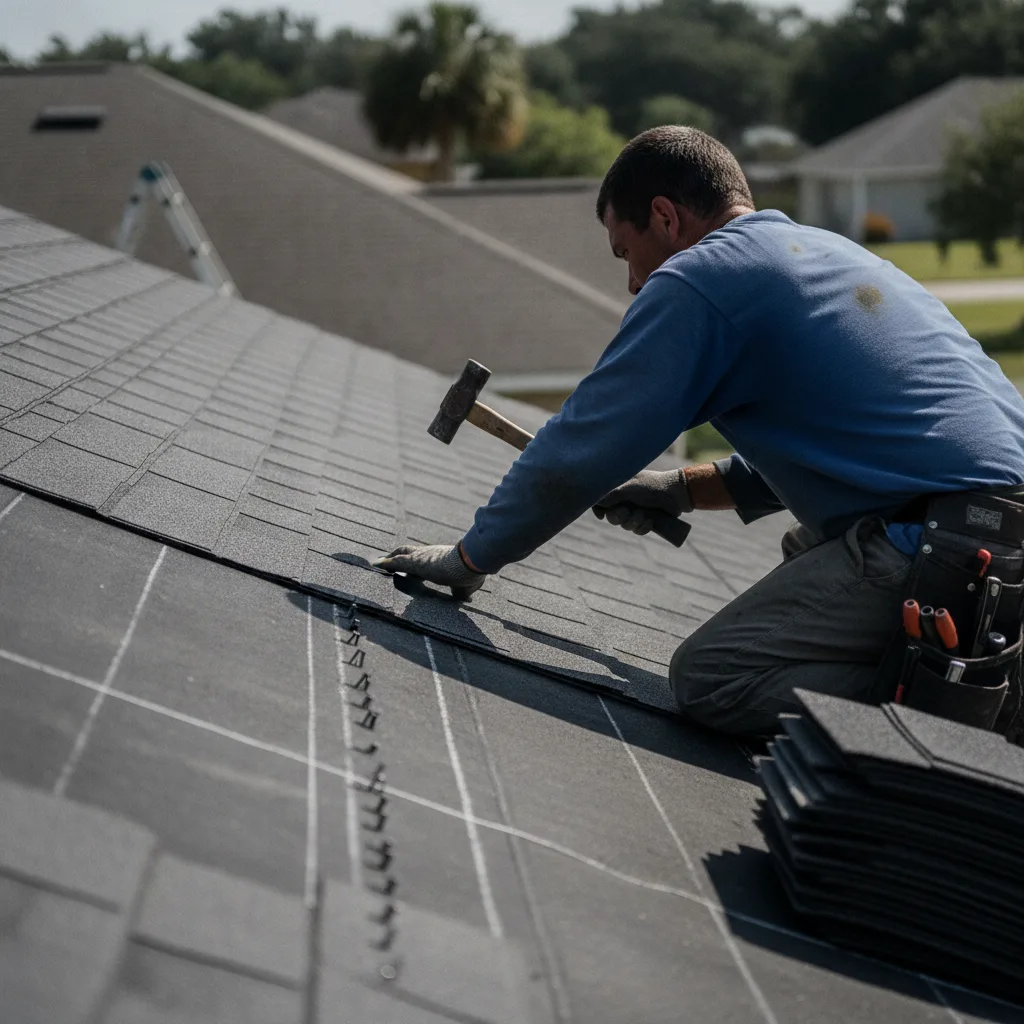
Our team in action — roofing professionals serving Jacksonville
Roof Installation Methods and Approaches We Use
Architectural Shingle Installation
The most common residential installation method in Jacksonville. Dimensional asphalt shingles are installed over secondary water barrier and synthetic underlayment using a 6-nail fastening pattern per the Florida High-Wind Zone requirement. Impact-resistant (Class 4) shingles are available and recommended for neighborhoods in Duval County’s highest wind exposure areas. Ideal for pitched roofs in Mandarin, Arlington, Southside, and the Beaches communities.
Flat and Low-Slope TPO Membrane Installation
Thermoplastic polyolefin (TPO) membrane is the leading choice for Jacksonville’s commercial flat roofs due to its white reflective surface, which reduces rooftop temperatures by up to 50°F compared to black membranes — a critical energy-saving factor during Jacksonville’s intense summers. Seams are heat-welded for watertight integrity. Learn more about our TPO roofing services.
Metal Roofing Installation
Standing seam and metal panel systems offer lifespans of 40–70 years and exceptional wind resistance — up to 160 mph when properly installed. Particularly well-suited to Jacksonville Beach and Atlantic Beach homes where salt air accelerates shingle degradation. Galvalume and aluminum alloy panels resist coastal corrosion. Explore our metal roofing options.
Concrete and Clay Tile Installation
Popular in Jacksonville’s upscale neighborhoods including Deerwood, Sweetwater, and Ponte Vedra Beach. Tile installation requires specialized underlayment systems and reinforced decking. Properly installed tile resists winds exceeding 150 mph and can last 50+ years in Florida’s climate. View our tile roofing services.
EPDM Rubber Roofing Installation
Ethylene propylene diene monomer (EPDM) membrane is ideal for low-slope commercial and residential flat roofs in Jacksonville’s rain-heavy environment. Fully adhered systems prevent wind uplift and the membrane’s flexibility accommodates thermal expansion in extreme summer heat. Discover our EPDM roofing solutions.
Ready for Roof Installation? Get Your Free Estimate Today.
Red Fox Roofers serves Jacksonville and the surrounding area — we’ll be on-site within 24 hours.
📞 Call (904) 906-4087Roof Installation Cost in Jacksonville, FL
Understanding the cost of roof installation helps Jacksonville homeowners and business owners plan appropriately. Pricing varies significantly based on material choice, roof size, pitch, and condition of the existing structure.
Typical Cost Ranges for Jacksonville Properties
- Architectural Asphalt Shingles: $4.50–$7.50 per square foot installed, or approximately $9,000–$18,000 for a typical 2,000 sq ft Jacksonville home
- Metal Roofing (Standing Seam): $10.00–$18.00 per square foot installed, or $20,000–$45,000 for a mid-size residence
- Concrete or Clay Tile: $9.00–$16.00 per square foot installed, ranging from $18,000–$40,000 depending on tile type and roof complexity
- TPO Flat Roofing (Commercial): $5.50–$9.00 per square foot installed for standard commercial applications
- EPDM Rubber Roofing: $5.00–$8.50 per square foot installed
Jacksonville-Specific Cost Factors
Several local factors influence your final installation price. Florida Building Code compliance adds 8–12% to material costs compared to non-hurricane-zone states due to secondary water barrier requirements, enhanced fastening schedules, and permit fees. Duval County permit fees typically range from $150–$400 for residential projects. Coastal properties in Atlantic Beach and Neptune Beach may require premium corrosion-resistant materials, adding $1.00–$2.50 per square foot to the base estimate. Decking replacement — common in older Jacksonville homes with moisture damage — typically adds $2.00–$4.00 per sheet of OSB replaced.
Request a detailed cost estimate for your specific Jacksonville property. We provide free, no-obligation written quotes.
Jacksonville Neighborhoods We Serve
Riverside and Avondale
These historic urban neighborhoods feature craftsman bungalows and colonial revival homes built primarily between 1910 and 1945. Steep-pitched roofs with complex valleys and dormers require experienced installation crews. Many homes here have original wood decking that must be assessed carefully before new roofing material is applied. We serve all of Riverside and Avondale’s historic housing stock.
Mandarin and Fruit Cove
Developed heavily from the 1980s through the 2000s, Mandarin and adjacent Fruit Cove in St. Johns County feature large subdivisions with standard architectural shingle roofs now reaching end of life. Hurricane Matthew in 2016 caused widespread shingle damage across this corridor, and many homes are on their second post-storm roof.
Atlantic Beach and Neptune Beach
Salt air within the 1–3 mile coastal zone accelerates roofing material degradation. We specify corrosion-resistant flashing and fasteners for every installation in these communities, protecting your investment from the aggressive marine environment unique to Jacksonville’s barrier island communities.
Southside and Deerwood
A mix of upscale residential communities and commercial corridors makes Southside one of Jacksonville’s most diverse roofing markets. Tile roofing is common in Deerwood and Deercreek estates, while commercial buildings along Baymeadows and Philips Highway require flat roofing expertise.
Palm Valley and Ponte Vedra
Luxury homes in the Palm Valley and Ponte Vedra corridor often feature high-end tile or metal roofing systems. We provide premium installation services matched to the quality standards of these upscale communities while meeting all St. Johns County building code requirements.
Roof Maintenance Tips for Jacksonville Homeowners
A properly installed roof still requires regular maintenance to achieve its full service life in Jacksonville’s demanding climate. Follow these location-specific tips:
- Inspect After Every Named Storm: Jacksonville’s hurricane season runs June 1 through November 30. Walk the perimeter of your home after any tropical event to check for missing shingles, displaced flashing, or clogged gutters.
- Clean Gutters Twice Annually: Jacksonville’s live oak canopy drops leaves and Spanish moss year-round. Clogged gutters cause water to back up under fascia and rot the roof’s leading edge — clean in spring and fall at minimum.
- Treat Algae and Moss Annually: Jacksonville’s humidity makes black algae streaks (Gloeocapsa magma) nearly universal on older shingles. Apply zinc sulfate treatments or install zinc strips at the ridge to prevent recurrence.
- Trim Overhanging Trees: Branches touching your roof abrade shingle granules and provide a moisture pathway. Keep tree branches at least 6 feet clear of the roofline.
- Inspect Attic Ventilation Seasonally: Proper attic airflow reduces heat buildup that degrades shingles from below. Verify ridge vents and soffit vents are clear before Jacksonville’s summer heat peaks.
- Check Flashing at All Penetrations: Jacksonville’s heavy rain events test every flashing seal. Inspect around HVAC curbs, skylights, and pipe boots annually.
- Schedule a Professional Inspection Every 3 Years: Our roof inspection service identifies early-stage problems before they become full replacements.
Why Choose Red Fox Roofers for Roof Installation in Jacksonville
Red Fox Roofers is a Jacksonville-based roofing contractor with deep roots in the Northeast Florida community. We are not a storm-chasing company that arrives after a hurricane and disappears — we live and work here, and our reputation is built on installations that perform through the next storm season and beyond.
Our installation teams are trained specifically on Florida Building Code requirements, including the high-wind fastening schedules, secondary water barrier mandates, and coastal zone material specifications that out-of-state contractors frequently overlook. We pull proper permits for every job in Duval, St. Johns, and surrounding counties — protecting you from liability and ensuring your installation passes final inspection.
We offer Jacksonville homeowners and businesses the full spectrum of roofing solutions: shingle roofing, metal roofing, tile roofing, TPO roofing, EPDM rubber roofing, and flat roofing systems — all installed by experienced local crews who understand Jacksonville’s unique climate demands.
Call (904) 906-4087 to speak with a Jacksonville roof installation specialist today.
Frequently Asked Questions About Roof Installation in Jacksonville, FL
How much does roof installation cost in Jacksonville, FL?
Most Jacksonville residential roof installations range from $9,000 to $40,000 depending on the material selected, roof size, and complexity. A standard 2,000 sq ft home with architectural shingles typically costs $9,000–$18,000 installed. Metal roofing and tile installations cost more upfront but last significantly longer in Jacksonville’s climate. Florida Building Code compliance adds cost versus states with lower wind requirements, but provides essential storm protection.
How long does roof installation take in Jacksonville?
Most residential shingle installations in Jacksonville are completed in 1–3 days once materials are on site. Tile and metal roofing projects may require 3–5 days. Add 3–5 business days for Duval County permit issuance before work begins. We plan installations around Jacksonville’s afternoon thunderstorm patterns to maximize safe, dry working hours.
Do I need a permit for roof installation in Jacksonville?
Yes. Duval County requires a building permit for any full roof installation. This is non-negotiable under Florida law. Red Fox Roofers files all required permits and schedules the mandatory building department final inspection on your behalf. Be cautious of any contractor who suggests skipping the permit process — it creates significant liability for the homeowner.
What roofing material is best for Jacksonville’s climate?
For most Jacksonville homeowners, impact-resistant architectural shingles rated for Florida’s High-Wind Zone offer the best balance of cost and performance. For coastal properties in Atlantic Beach and Neptune Beach, metal roofing’s corrosion resistance makes it superior long-term. Tile roofing excels in upscale Southside and Ponte Vedra communities where longevity and aesthetics are priorities. TPO and EPDM are the top choices for commercial flat roofs throughout the Jacksonville metro.
Will my homeowner’s insurance cover roof installation in Jacksonville?
If your roof was damaged by a named storm, hail, or sudden weather event, your Jacksonville homeowner’s insurance policy likely covers the installation cost minus your deductible. However, roofs replaced due to age or normal wear are typically not covered. After Hurricane Matthew and Irma, many Jacksonville insurers tightened their policies — we can help document storm-related damage to support your insurance claim.
How long will my new roof last in Jacksonville?
In Jacksonville’s subtropical climate, architectural asphalt shingles typically last 20–25 years (versus 30 years in cooler climates), metal roofing 40–70 years, concrete or clay tile 40–50+ years, and TPO or EPDM flat roofing 15–25 years. Proper installation, Florida-code-compliant materials, and regular maintenance are the biggest determinants of lifespan in this environment.
Do you serve areas outside Jacksonville proper?
Yes. Red Fox Roofers serves Jacksonville and the greater Northeast Florida region, including Atlantic Beach, Neptune Beach, Jacksonville Beach, Palm Valley, and Fruit Cove. We are familiar with the building codes and permit requirements in both Duval County and St. Johns County.
What is a secondary water barrier and why is it required in Jacksonville?
A secondary water barrier (SWB) is a self-adhering peel-and-stick membrane applied directly to the roof deck beneath the primary underlayment and shingles. Florida Building Code requires SWB on all new roof installations statewide. It provides a second line of defense if wind peels back shingles during a hurricane — a critical protection given Jacksonville’s exposure to storms like Matthew and Irma. Any Jacksonville roofing contractor who omits this step is violating state code.
Get Your Free Roof Installation Estimate in Jacksonville Today
Whether you are building a new home in Palm Valley, replacing a storm-damaged roof in Atlantic Beach, or upgrading an aging shingle system in Mandarin, Red Fox Roofers is Jacksonville’s trusted partner for professional roof installation. We combine local climate expertise, strict Florida Building Code compliance, and top-tier materials to deliver roofs that protect your home through every hurricane season.
Do not wait until the next storm season reveals a failing roof. Contact us today for a free, no-obligation written estimate.
- Call or Text: (904) 906-4087
- Service Area: Jacksonville, Atlantic Beach, Neptune Beach, Jacksonville Beach, Palm Valley, and Fruit Cove, FL
Request your free roof installation estimate online — we respond to all Jacksonville inquiries within one business day.
- Metal Roof Installation